Content
Yes, you can make coffee with distilled water — but you probably shouldn't rely on it exclusively. Distilled water is 100% pure H₂O with all minerals removed, which sounds ideal for a clean cup, but coffee extraction actually depends on minerals like magnesium and calcium to pull flavor compounds out of the grounds. Without them, your coffee may taste flat, sour, or hollow — technically brewed, but missing something. That said, distilled water has its place, particularly when blended with mineral-rich water or when you're experimenting with total control over your brew chemistry.
This article breaks down exactly what happens when you use distilled water for coffee, what the science says, how water distillers factor in, and what alternatives give you better results without the guesswork.
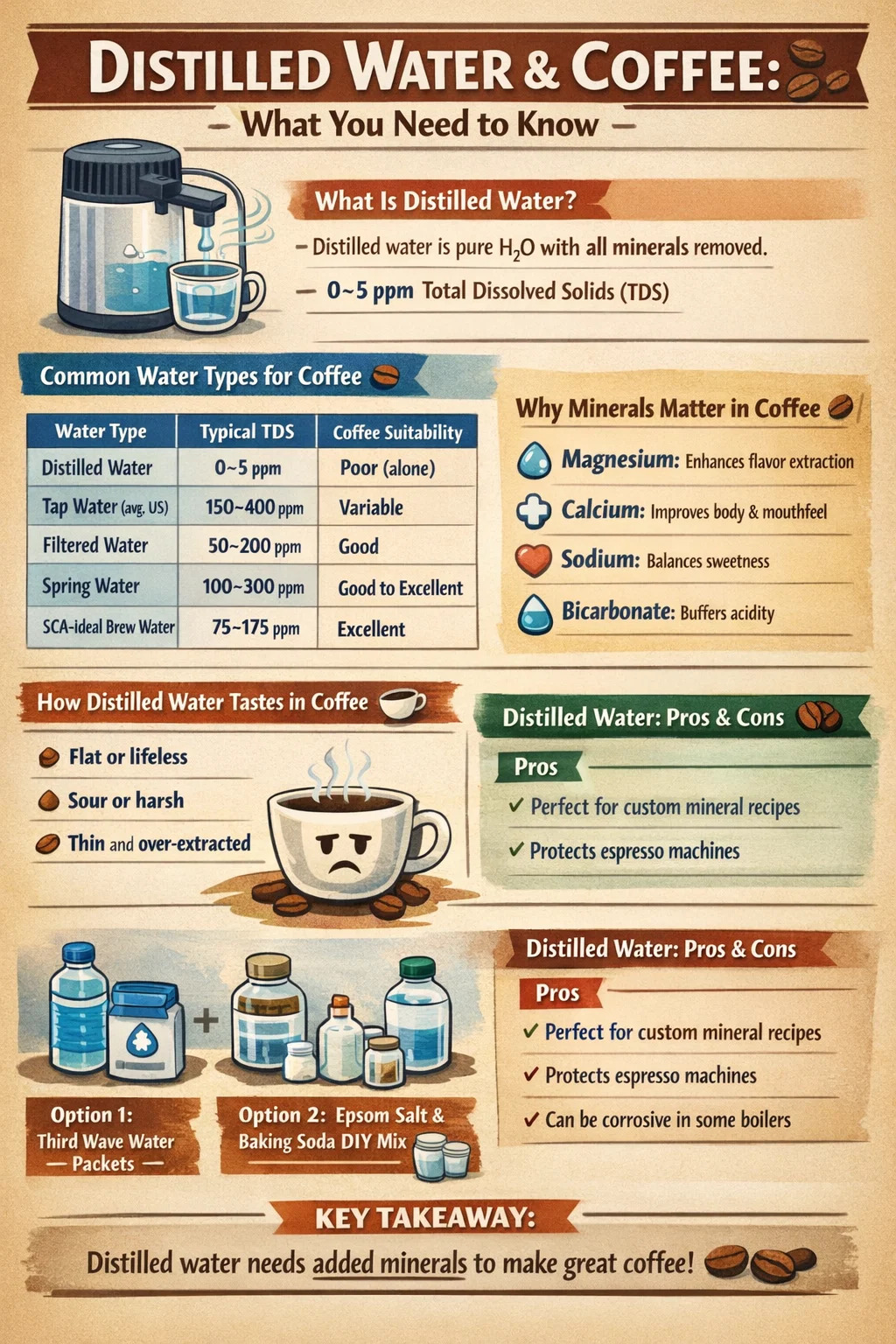
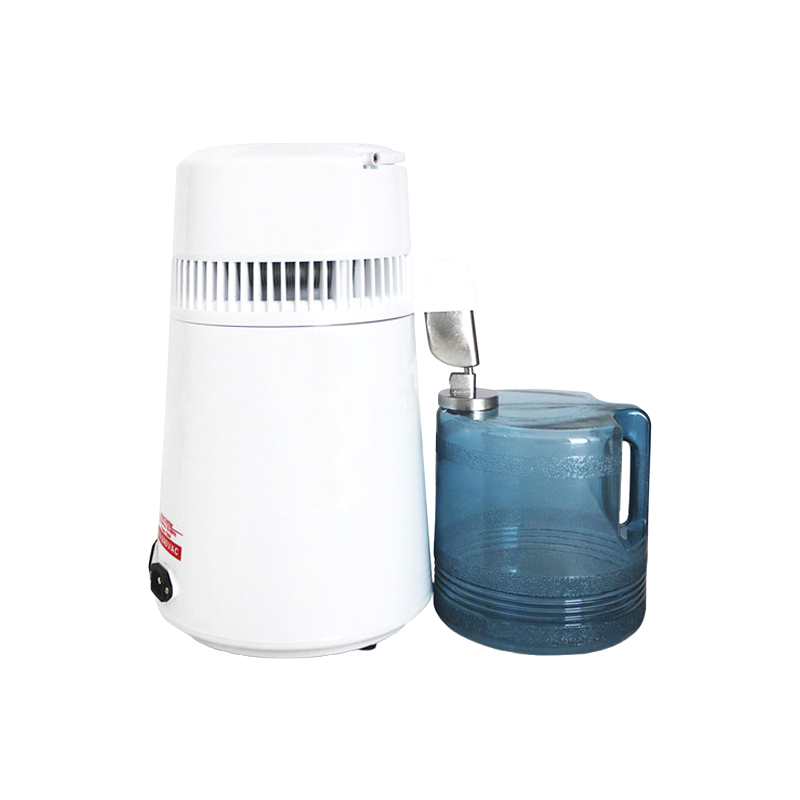
A water distiller works by heating water to its boiling point, collecting the steam, and condensing it back into liquid form. This process removes virtually everything that isn't water — including heavy metals, chlorine, bacteria, pesticides, and crucially, dissolved minerals like calcium, magnesium, sodium, and potassium. The result is water with a total dissolved solids (TDS) reading near zero, typically between 0–5 ppm (parts per million).
Compare that to other common water types used in coffee preparation:
| Water Type | Typical TDS (ppm) | Mineral Content | Coffee Suitability |
|---|---|---|---|
| Distilled Water | 0–5 | None | Poor (alone) |
| Tap Water (avg. US) | 150–400 | Moderate to high | Variable |
| Filtered Water (e.g., Brita) | 50–200 | Low to moderate | Good |
| Spring Water | 100–300 | Naturally present | Good to excellent |
| SCA-Ideal Brew Water | 75–175 | Calibrated | Excellent |
The Specialty Coffee Association (SCA) publishes water quality standards for brewing: a target TDS of 150 ppm, acceptable range 75–250 ppm, with a target hardness of 50–175 ppm calcium carbonate. Distilled water at 0–5 ppm sits far outside that window — it's not the tool for standard coffee brewing.
Coffee is a remarkably complex beverage — a single cup contains over 1,000 flavor compounds. Not all of them dissolve at the same rate or respond to water the same way. This is where mineral content becomes a meaningful variable, not a trivial one.
Research published in the journal Scientific Reports found that magnesium ions are particularly effective at extracting aromatic compounds from coffee grounds. Water higher in magnesium tends to produce brighter, fruitier, more complex cups. This is why some specialty roasters and barista competition brewers deliberately build water recipes with elevated magnesium — often targeting 20–30 ppm of magnesium specifically.
Calcium contributes to mouthfeel and the perceived body of coffee. Without it, even a well-extracted coffee can feel thin and watery on the palate. Too much calcium, on the other hand, leads to excessive hardness and scale buildup in espresso machines — one of the primary reasons home baristas use a water distiller to create mineral-free base water they can then customize.
Small amounts of sodium — around 10 ppm — have been shown to suppress bitterness and enhance perceived sweetness in coffee. Distilled water contains no sodium, so you lose this subtle balancing effect. The difference is most noticeable in lower-quality or darker-roasted coffees where bitterness is more pronounced.
Bicarbonate acts as a buffer, neutralizing some of the acids in coffee. Very low bicarbonate water (like distilled water) can result in a more acidic cup — which some light roast lovers prefer, but which others find sharp and harsh. The SCA recommends a bicarbonate level of around 40 ppm for balanced brewing.
If you've never tried it, the result may surprise you. Most people describe coffee brewed with pure distilled water as:
There are exceptions. Some very delicate, ultra-light roast coffees brewed at precise parameters using distilled water as a base — with carefully added minerals — can produce exceptional cups. But that's not the same as pouring unmodified distilled water into your drip machine.
Blind taste tests run by coffee research groups and community experiments on platforms like Reddit's r/Coffee and various barista forums consistently show that participants rank distilled-water coffee lower than spring or filtered water brews when tasted side by side, even without knowing which was which.
Despite the flavor limitations, a water distiller is genuinely useful in a coffee context — just not in the way most people assume. The real value is as a starting point for building custom water profiles, not as a direct brewing water source.
Specialty coffee enthusiasts — particularly those who compete or who brew with expensive single-origin beans — use distilled water as a mineral-free canvas. They then add precise amounts of food-grade mineral concentrates to hit exact targets. Common recipes include:
This approach gives you total control. If your tap water is highly variable in quality — common in older city infrastructure or rural well systems — having a water distiller means you always start from a known baseline and build from there.
Hard water is the single biggest enemy of espresso machines. Calcium and magnesium deposits build up inside boilers, heat exchangers, and group heads — reducing efficiency, causing overheating, and eventually requiring expensive descaling or component replacement. A home water distiller removes the minerals responsible for scale before they ever enter the machine.
Many espresso machine manufacturers — including Breville, Jura, and De'Longhi — recommend using filtered or softened water specifically to reduce scale. Some even void warranties if damage from limescale is evident. Using distilled water (or distilled water remineralized to a low, machine-safe TDS) addresses this directly.
Municipal water composition can shift seasonally. Runoff from spring snowmelt, changes in source water, or variations in treatment plant chemistry can all alter your tap water's mineral content month to month. For a coffee shop or competition brewer who needs every cup to taste the same, a water distiller paired with a mineral addition protocol eliminates this inconsistency entirely.
A water distiller isn't the only way to purify water, and for coffee purposes, it's worth knowing what each method delivers.
| Method | Removes Minerals? | Removes Chlorine? | Best Use Case for Coffee |
|---|---|---|---|
| Water Distiller | Yes (100%) | Yes | Custom mineral recipes, equipment protection |
| Reverse Osmosis (RO) | Yes (95–99%) | Yes | Similar to distilled; often used in commercial cafés |
| Activated Carbon Filter | No | Yes | Best everyday filter for most home brewers |
| Water Softener (ion exchange) | Partially (replaces Ca/Mg with Na) | No | Not recommended — elevates sodium, affects taste |
| UV Purification | No | No | Targets bacteria only; doesn't affect brew water quality |
For most home brewers, a simple activated carbon filter (like a pitcher or under-sink filter) delivers the best balance — removing chlorine and off-flavors while leaving mineral content intact at roughly the right levels. A water distiller makes more sense for enthusiasts, equipment owners, or people dealing with severely hard or contaminated source water.
If you have a water distiller at home and want to use it for coffee without giving up flavor, the fix is straightforward: add minerals back in controlled amounts. Here are three practical approaches, ranging from the simplest to the most precise.
Third Wave Water sells pre-portioned mineral packets designed specifically to be dissolved in one gallon of distilled water. Each packet is formulated for either espresso or drip coffee, hitting mineral targets consistent with SCA recommendations. One packet per gallon, stir to dissolve, done. TDS comes out around 150 ppm. This is the easiest no-math option.
This is a popular approach in the home coffee community and requires only two ingredients available at any pharmacy or grocery store:
Scale carefully. A digital scale accurate to 0.01g makes the process much more repeatable. Make a concentrate — dissolve 10g of each into 100ml of distilled water — then add 1ml of that concentrate per liter of brewing water. This allows far more precision than measuring dry powder in small amounts.
The simplest method of all: mix distilled water with a mineral-containing water at a fixed ratio. A 50/50 blend of distilled water and most commercial spring waters will roughly halve the mineral content of the spring water — useful if your tap water or preferred spring water is very hard. A 25% distilled / 75% spring water ratio is a good starting point for high-hardness scenarios. No math, no measuring of powders — just mixing.
This is a question that often comes up alongside the flavor discussion, and the answer is nuanced. Distilled water won't damage most brewing equipment in typical home use scenarios, but there are a few things to be aware of.
Very pure, low-TDS water is slightly more corrosive than mineral-rich water because it's chemically "hungry" — it will leach trace amounts of metals from whatever container it's in. Over years of use, this could theoretically affect the interior of copper or brass boilers in high-end espresso machines. In practice, the effect is minimal for most home users, but some machine manufacturers note this risk and recommend avoiding pure distilled water for extended use. Remineralizing to 50+ ppm eliminates this concern.
Espresso machines with boilers — particularly those used for steaming milk — require some mineral content to function correctly. Some machine sensors and heating elements are calibrated assuming water with standard mineral content. Operating with pure distilled water for extended periods can cause irregular behavior in certain models. Again, adding minerals back resolves this.
Standard drip machines, French presses, pour-over setups, and AeroPress brewers are all essentially inert materials — stainless steel, borosilicate glass, BPA-free plastic, or ceramic. None of these are meaningfully affected by distilled water. Use it freely from an equipment standpoint; just expect the flavor limitations discussed above.
If you've decided a water distiller fits your coffee setup — whether for equipment protection, recipe control, or general water quality concerns — there are a few practical considerations for selecting one.
For coffee use, a countertop water distiller is almost always sufficient. They typically produce 1 gallon (3.8 liters) every 4–6 hours and cost between $80 and $300 depending on features and build quality. Whole-house distillation units exist but are expensive, slow, and unnecessary for one or two people brewing coffee at home.
A standard espresso shot uses around 60–90ml of water. A single cup of drip coffee requires roughly 350–400ml. A full carafe of 10 cups uses close to 1.8 liters. If you're making multiple cups per day and remineralizing distilled water for every brew, you'll want to produce and store distilled water in larger batches — ideally 2–4 gallons at a time — to avoid constantly waiting for the distiller to cycle.
Distilled water doesn't expire in any meaningful timeframe, but it can absorb CO₂ from the air, which slightly lowers its pH. Store it in sealed glass or food-grade HDPE plastic containers rather than open pitchers. Don't store it in reactive metal containers — remember its slightly leaching nature. If you remineralize it, the minerals buffer against pH drift and the water keeps well for weeks.
Water distillers are energy-intensive compared to filter pitchers. A typical countertop unit draws 750–1000 watts for 4–6 hours per gallon — roughly 3–5 kWh per gallon of distilled water. At the US average electricity rate of around $0.16/kWh, that's about $0.48–$0.80 per gallon produced. Factor this into your decision if you're distilling daily.
Here's the short version of when distilled water — or a water distiller — makes sense in a coffee context:
The bottom line: distilled water and coffee can absolutely coexist, but treating a water distiller as the final step — rather than the first step — in your water prep is what separates a flat, disappointing brew from a genuinely excellent one.
If you have any question for the installation
or need support, please feel free to contact us.
86-15728040705
86-18957491906

 English
 عربى
عربى

