Content
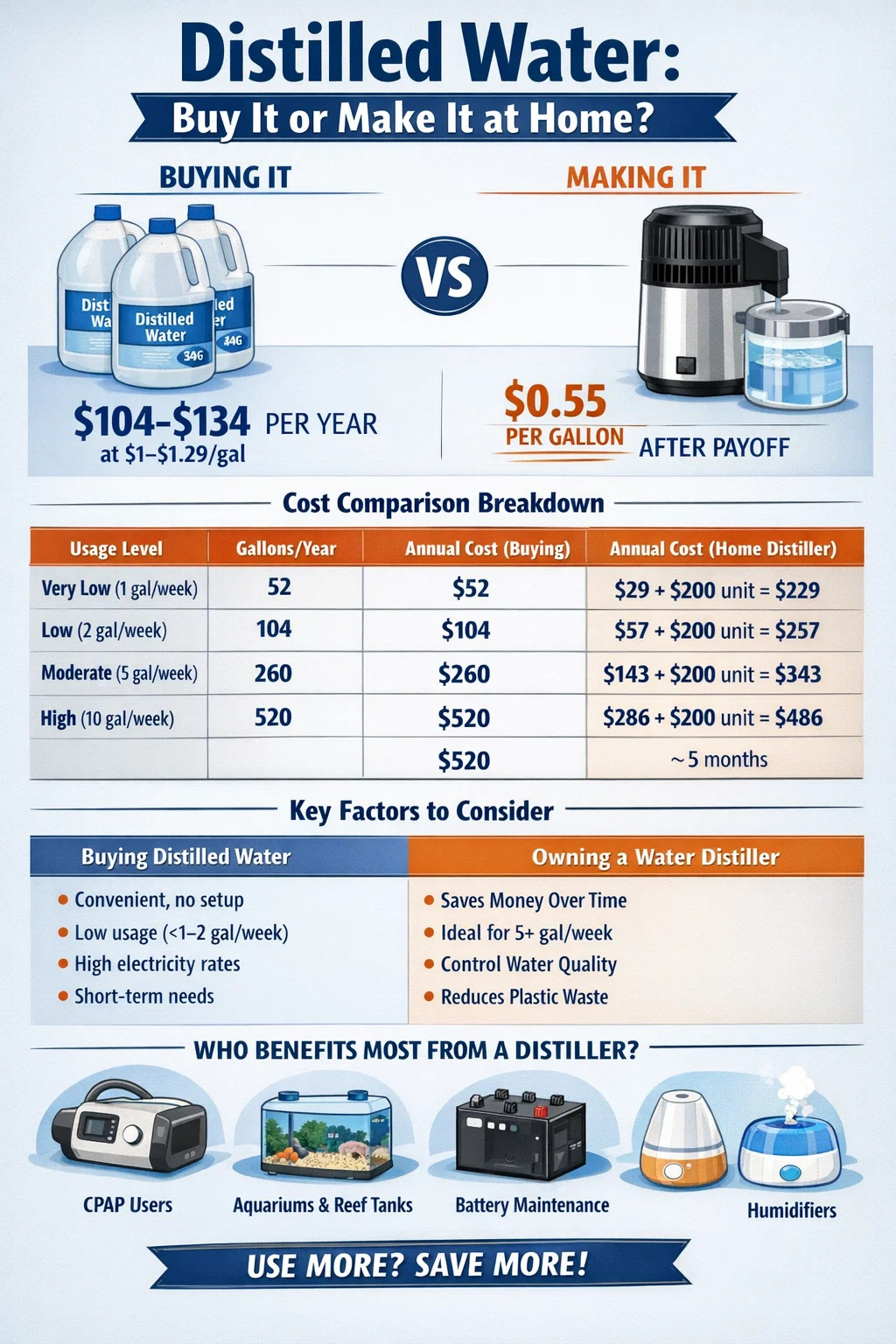
Making distilled water at home with a water distiller is almost always cheaper per gallon than buying it bottled — but only after you recover the upfront cost of the machine. Store-bought distilled water typically runs $0.89 to $1.50 per gallon, while home distillation costs roughly $0.25 to $0.50 per gallon once you account for electricity. The break-even point for most countertop water distillers lands somewhere between 3 and 18 months depending on how much you use and which unit you buy.
That said, the math isn't identical for everyone. If you only occasionally need a gallon for your iron or humidifier, buying it is perfectly reasonable. If you're running a CPAP machine every night, filling a large aquarium, or topping off a battery bank weekly, a home water distiller pays for itself fast and keeps saving you money for years.
This article works through the full cost comparison — purchase price, electricity, maintenance, and real-world usage scenarios — so you can make an informed decision rather than guessing.
Walk into any Walmart, Kroger, CVS, or grocery chain and you'll find gallon jugs of distilled water in the water aisle. Prices vary by region and retailer, but the range is fairly consistent across the US:
Some grocery stores also offer distilled water refill stations — the kind where you bring your own jug and fill it by the gallon — priced around $0.35–$0.49 per gallon. These are cheaper than jugs but require you to haul containers back and forth, and availability varies widely by location.
Now consider what those prices add up to over time. If you use 2 gallons of distilled water per week — a reasonable amount for a CPAP user plus regular household needs — that's roughly 104 gallons per year. At $1.00/gallon, you're spending $104 per year on store-bought distilled water. At $1.29, it's $134. Over five years, that's $520–$670 for one family's distilled water habit — before accounting for plastic waste or the inconvenience of regularly buying heavy jugs.
Usage scales quickly too. CPAP machines use about 1 gallon per week on average. A humidifier running through winter might consume another 1–2 gallons weekly. A saltwater aquarium needing regular top-offs can require 3–5 gallons per week. Lead acid batteries in a solar setup or backup power bank need periodic distilled water. Stack those uses together and 5–10 gallons per week isn't unusual, pushing annual store-bought costs to $260–$520 per year or more.
A home water distiller has two cost components: the upfront purchase price and the ongoing electricity cost per gallon. Both matter, and neither should be ignored.
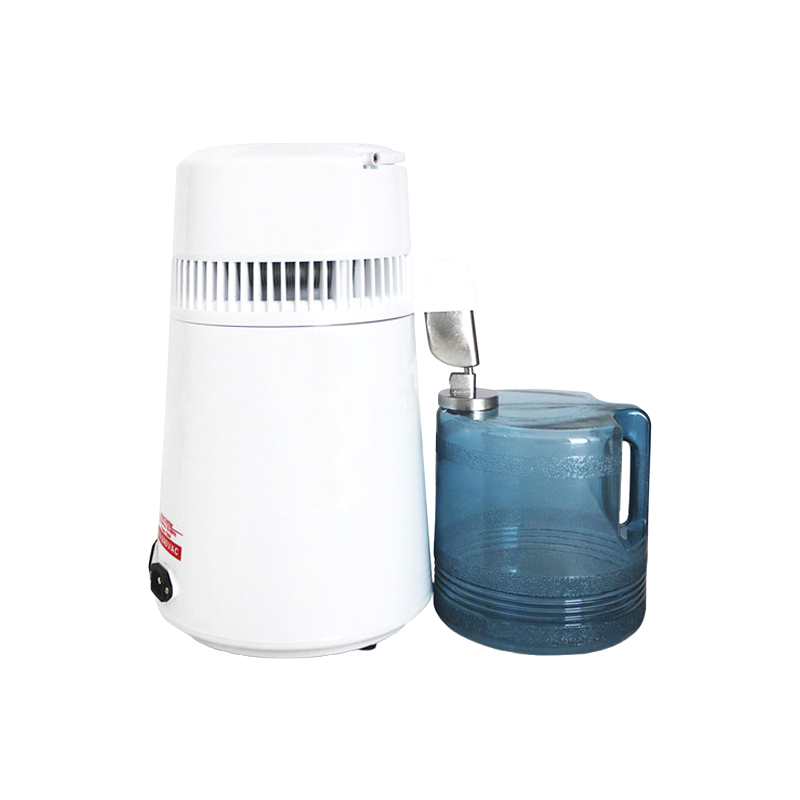
Countertop water distillers — the most common type for home use — span a wide price range depending on build quality, capacity, and brand. Here's a general breakdown of the market:
| Price Range | Typical Output | Build Quality | Example Use Case |
|---|---|---|---|
| $80–$120 | 1 gallon / 4–6 hrs | Basic plastic housing | Occasional use, CPAP |
| $150–$250 | 1 gallon / 4–5 hrs | Stainless steel boiler | Daily use, family household |
| $300–$500 | 1–1.5 gallons / 4 hrs | Full stainless, auto shutoff, timer | Heavy use, aquariums, labs |
| $600–$1,500+ | 4–12 gallons / day | Commercial grade | Small business, clinic, farm |
For the vast majority of households, a unit in the $150–$250 range hits the sweet spot — durable enough for daily operation, made with stainless steel components that don't leach into the water, and fast enough to keep up with typical demand without running the machine around the clock.
This is the ongoing cost that most people overlook when comparing home distillation to buying. A standard countertop water distiller draws between 750 and 1,000 watts of power and takes approximately 4–6 hours to produce one gallon of distilled water. That translates to roughly 3–5 kWh of electricity per gallon.
The US average retail electricity rate as of 2024 is approximately $0.16 per kWh, though it ranges from around $0.10/kWh in states like Louisiana and Idaho to $0.30+/kWh in Hawaii and parts of California and New England.
At the national average rate:
If you live in a low-electricity-cost state and have a modern, efficient distiller, your per-gallon cost might be as low as $0.25–$0.30. If you're in Hawaii or Connecticut paying $0.30/kWh, expect $0.75–$1.00 per gallon — which starts to look less compelling compared to buying.
Most water distillers also use activated carbon post-filters — small sachets or cartridges placed in the collection bottle to remove any volatile organic compounds (VOCs) that survive the distillation process. These typically cost $10–$25 for a pack of 12–24 filters, with each filter lasting one to two gallons of output. That adds roughly $0.50–$1.00 per filter, or around $0.25–$0.50 per gallon if each filter handles two gallons.
Some users skip carbon filters for non-drinking applications (battery top-off, aquarium, steam iron) and only use them for CPAP or drinking water. That selective approach reduces the consumable cost significantly.
The boiling chamber also needs periodic cleaning to remove mineral scale. Depending on your tap water hardness, you'll do this every 5–20 gallons using white vinegar or a citric acid solution — both of which cost nearly nothing. This takes 15–30 minutes and is not a significant expense, just a minor routine task.
Pulling the numbers together gives you a clearer picture. The following table compares the total cost of distilled water under different scenarios, assuming a mid-range water distiller purchased for $200 and average US electricity at $0.16/kWh:
| Usage Level | Gallons/Year | Annual Cost (Buying @ $1.00/gal) | Annual Cost (Home Distiller @ $0.55/gal*) | Break-Even (months) |
|---|---|---|---|---|
| Very Low (1 gal/week) | 52 | $52 | $29 + $200 unit = $229 yr 1 | ~44 months |
| Low (2 gal/week) | 104 | $104 | $57 + $200 unit = $257 yr 1 | ~26 months |
| Moderate (5 gal/week) | 260 | $260 | $143 + $200 unit = $343 yr 1 | ~17 months |
| High (10 gal/week) | 520 | $520 | $286 + $200 unit = $486 yr 1 | ~5 months |
The pattern is consistent: the more you use, the faster a water distiller pays off. At 10 gallons per week — not unusual for households combining CPAP use, humidifier, aquarium maintenance, and drinking water — you break even in around 5 months and save roughly $234 per year after that, every year the machine keeps running.
At 1 gallon per week, the math gets less favorable. You won't break even for nearly four years, and by that point you'd better hope the machine is still running well. For truly occasional use, buying remains the more practical option.
Electricity cost is the single biggest variable in the home distillation cost equation, and it varies dramatically across the US and other countries. The same water distiller running the same number of hours produces wildly different per-gallon costs depending on where you live.
| State / Region | Avg. Rate ($/kWh) | Cost per Gallon (4 kWh) | Home Distilling Verdict |
|---|---|---|---|
| Louisiana | $0.10 | $0.40 | Excellent savings |
| Texas | $0.12 | $0.48 | Good savings |
| US Average | $0.16 | $0.64 | Moderate savings |
| California (PG&E territory) | $0.28 | $1.12 | Marginal or no savings |
| Hawaii | $0.40+ | $1.60+ | Buying is cheaper |
If you live in Hawaii or parts of high-rate California, the electricity alone to run a water distiller may cost more than buying distilled water at the store. In those cases, the refill station at your local grocery store — typically $0.35–$0.49 per gallon — becomes the smartest choice for high-volume users.
If you're in the middle of the country paying $0.10–$0.13/kWh, home distillation starts looking very attractive even at moderate usage volumes.
Reverse osmosis (RO) is often mentioned alongside distillation as a method for producing very pure water at home. They're not identical — RO removes 95–99% of dissolved minerals and most contaminants, while a water distiller removes essentially 100% — but for most practical uses, both deliver suitable output. The cost profiles are quite different.
Under-sink RO systems range from $150 to $600 installed. Annual filter replacement costs run $50–$150 depending on the system and membrane quality. Most RO systems also waste 2–4 gallons of water for every 1 gallon of purified output — a significant issue in water-restricted areas or if you're paying high municipal water rates. Per-gallon production cost for RO is typically $0.10–$0.25 not counting wasted water, and they produce water much faster than a distiller — typically 50–100 gallons per day for a standard under-sink unit.
If your primary concern is cost-per-gallon and high volume output, an RO system generally beats a countertop water distiller on price once installed. However, a water distiller has meaningful advantages in specific situations:
For apartment dwellers, people on well water with biological contamination, or anyone wanting maximum portability, a water distiller often makes more sense even if the cost-per-gallon is slightly higher than an installed RO system.
Abstract cost comparisons are useful, but looking at specific use cases makes the savings more concrete. Here are the situations where owning a water distiller produces the clearest financial benefit.
CPAP manufacturers universally recommend distilled water in humidifier chambers to prevent mineral buildup and bacterial growth. A typical CPAP user fills the chamber nightly — approximately 0.5 to 1 liter per use — consuming roughly 1 gallon (3.8 liters) per week. That's 52 gallons per year. At $1.00/gallon from the store, you spend $52 annually just on CPAP water. With a water distiller running at $0.50/gallon all-in, you spend $26/year on CPAP water after payback. Over a 5-year period on a $200 distiller, total cost of home distillation for CPAP alone comes to approximately $330 vs. $460 for store-bought — about 30% savings. If you're also using the distiller for other purposes, the savings compound quickly.
Humidifiers develop white mineral dust and scale far faster than CPAP machines — especially in hard water areas. A portable humidifier running in a bedroom through a 4-month winter might consume 2–3 gallons per week, or 35–50 gallons per season. Whole-home humidifiers attached to HVAC systems can use considerably more. Families who consistently buy distilled water for humidifiers through dry winter months often spend $35–$75 per season per unit. Multiple units in a larger home can push that well above $100 per winter on water alone.
Reef tank hobbyists are perhaps the most cost-conscious distilled water users. A reef tank needs top-off water (replacing evaporation) plus new salt water mixed for water changes. A 100-gallon display tank might need 3–5 gallons of top-off per week and a 20–30% water change monthly. That's easily 200–300 gallons of purified water per year for a single medium-sized system. Buying that at $1.00/gallon costs $200–$300 annually. A mid-range water distiller at $200 pays itself back in under a year in this scenario.
Flooded lead acid batteries — in solar energy storage banks, RVs, forklifts, and golf carts — require regular topping off with distilled water to maintain proper electrolyte levels. A bank of 8 golf cart batteries might need 1–2 gallons every month or two. An off-grid solar setup with 12–16 batteries can need considerably more. While total volume isn't extreme, the ongoing need makes keeping a water distiller on hand economically sensible for anyone maintaining battery systems long-term.
Home labs, photographers using wet darkroom processes, automotive detailers (spot-free rinse), and electronics repair technicians all have uses for high-purity water where mineral residue ruins the outcome. Buying distilled water by the gallon for these uses is standard practice, but even moderate professional volumes make a water distiller worthwhile. An automotive detailer doing final rinses on 3–5 cars per week using 2 gallons of distilled per car is going through 6–10 gallons weekly — over $300/year at retail, often much more.
The math doesn't always favor buying a water distiller. There are clear situations where purchasing distilled water by the jug is the smarter, cheaper, or more convenient choice.
Pure price-per-gallon comparisons miss some real factors on both sides of the equation that can meaningfully affect the total value proposition of owning a water distiller.
Each gallon of store-bought distilled water comes in a single-use HDPE plastic jug. At 2 gallons per week, that's 104 plastic jugs per year going into your recycling bin — or landfill, since HDPE recycling rates in the US hover around 30%. A water distiller producing into a reusable glass or stainless container eliminates that waste stream entirely. For environmentally-minded consumers, this matters independently of the cost math.
Buying distilled water means remembering to buy it, carrying heavy jugs, and running out at inconvenient times. A water distiller runs while you sleep or work. For CPAP users especially, running out of distilled water before bed is a real and recurring annoyance. Owning a distiller eliminates this problem permanently. The time and inconvenience cost of regular store runs has real value that doesn't appear in a cost-per-gallon calculation.
Store-bought distilled water is generally reliable, but production standards vary. Occasional contamination events have been documented — typically from inadequate packaging sanitation or post-distillation handling. A home water distiller you control and clean yourself produces water whose quality you can verify with a simple TDS meter ($10–$15 on Amazon). If the meter reads 0–5 ppm, you know the output is correct. That level of quality assurance isn't available when you buy sealed jugs.
A water distiller used consistently to supply pure water to appliances — CPAP humidifiers, steam irons, espresso machines, humidifiers — can extend the life of those appliances by reducing mineral scale buildup. A CPAP humidifier chamber that scales up and needs replacement every year or two at $20–$50 per replacement, versus one that stays clean for 5+ years, represents real money saved. The same logic applies to steam iron cleanouts, humidifier wick replacements, and espresso machine descaling. The indirect equipment protection benefit can easily exceed $50–$100 per year for households with multiple appliances depending on distilled water.
Run through these four questions and the right answer becomes fairly clear:
For most households in the US using 2 or more gallons of distilled water per week, paying average electricity rates, and planning to maintain that usage for at least two years, a mid-range countertop water distiller in the $150–$250 range pays for itself and generates meaningful ongoing savings. The convenience and quality benefits add further value that the raw numbers alone don't capture.
If you have any question for the installation
or need support, please feel free to contact us.
86-15728040705
86-18957491906

 English
 عربى
عربى

