Content
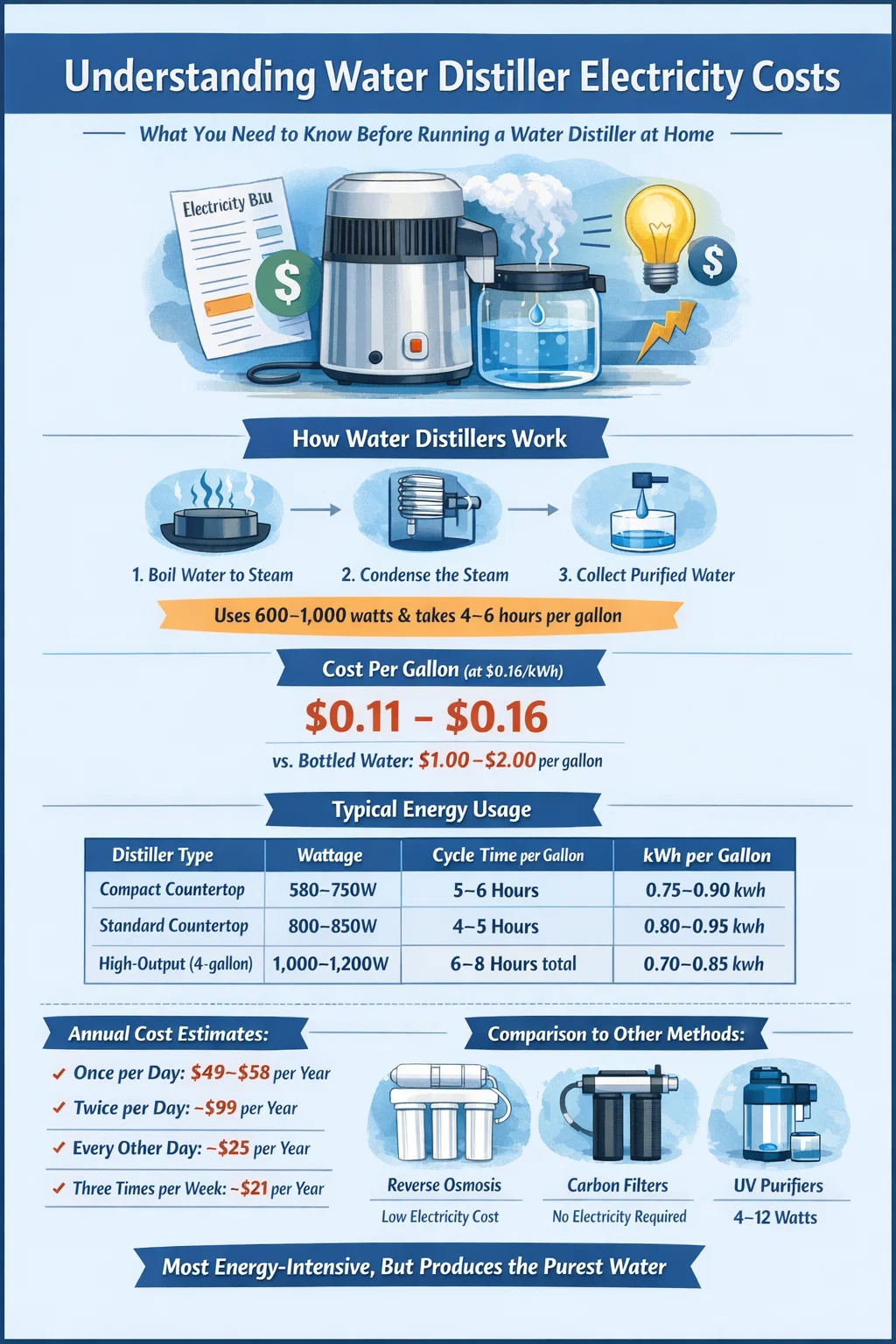
Water distillers do consume a noticeable amount of electricity compared to other countertop water purification methods. A typical home water distiller uses between 600 and 1,000 watts of power and takes approximately 4 to 6 hours to produce one gallon of distilled water. That translates to roughly 0.7 to 1 kWh per gallon. Whether that counts as "a lot" depends entirely on your local electricity rate, how often you run the machine, and what you're comparing it to.
For most households in the United States, where the average electricity rate sits around $0.16 per kWh, producing one gallon of distilled water costs somewhere between $0.11 and $0.16. Run the distiller once a day for a full year, and you're looking at roughly $40 to $58 annually just in electricity. That's far less than buying bottled distilled water at the store, which typically runs $1 to $2 per gallon, but it is meaningfully more than what a reverse osmosis system or a simple carbon filter would cost to operate.
So the honest answer is this: water distillers are not energy-efficient appliances, but for most households they are entirely affordable to run. The key is understanding exactly what's happening electrically and making smart choices about when and how often you operate yours.
To understand the electricity consumption of water distillers, it helps to know what they're actually doing inside. The distillation process works by heating water to its boiling point — 212°F (100°C) — turning it into steam, channeling that steam through a cooling coil, and then condensing it back into liquid form in a clean collection container. Everything that was dissolved in the original water — minerals, heavy metals, bacteria, most chemicals — stays behind in the boiling chamber.
That boiling process is the energy-intensive part. Water has an exceptionally high specific heat capacity, meaning it takes a substantial amount of energy to raise its temperature. Getting a full gallon of tap water from room temperature (around 70°F) all the way to boiling, and then sustaining that boil long enough to evaporate the entire volume, requires a consistent draw of electricity over several hours.
Most countertop water distillers use a heating element rated between 750W and 850W. Some compact models dip as low as 580W, while larger or commercial-grade units can exceed 1,200W. The wattage rating tells you how fast the unit runs — a higher-wattage distiller heats water faster and completes a cycle in less time, while a lower-wattage model takes longer but draws less power at any given moment. The total energy consumed per gallon often ends up similar regardless.
Many countertop water distillers include a small electric fan to cool the condensing coil. This fan typically draws an additional 30 to 60 watts. While that's a small fraction of the total, it does run throughout the cycle and contributes to the overall energy bill. Some stainless steel or air-cooled models rely entirely on passive airflow and eliminate the fan entirely, which can marginally reduce consumption.
Most modern home water distillers include an automatic shut-off mechanism that cuts power once the boiling chamber runs dry at the end of a cycle. This is an important efficiency feature — it prevents the heating element from continuing to run with no water present, which would waste electricity and potentially damage the unit. If your distiller lacks this feature, you're almost certainly wasting energy every cycle.
Not all water distillers consume electricity at the same rate. The table below breaks down typical energy usage figures across several common categories of water distillers, from small countertop units designed for personal use to larger systems built for whole-household or light commercial purposes.
| Distiller Type | Wattage | Cycle Time (per gallon) | kWh per Gallon | Daily Cost (at $0.16/kWh) |
|---|---|---|---|---|
| Compact countertop (1-gallon) | 580–750W | 5–6 hours | 0.75–0.90 kWh | $0.12–$0.14 |
| Standard countertop (1-gallon) | 800–850W | 4–5 hours | 0.80–0.95 kWh | $0.13–$0.15 |
| High-output countertop (4-gallon) | 1,000–1,200W | 6–8 hours total | 0.70–0.85 kWh | $0.45–$0.55 (per run) |
| Commercial / continuous-flow | 2,000–5,000W+ | Continuous | 0.60–0.80 kWh | Varies by output |
One interesting pattern in the data: higher-wattage distillers don't necessarily use more electricity per gallon than lower-wattage ones. A 1,000W unit that completes a 4-gallon cycle in 7 hours uses about 7 kWh total — that's 1.75 kWh per gallon. But a well-designed 850W countertop model completing a single gallon in 4.5 hours uses roughly 0.85 kWh. The relationship between power rating and efficiency is more nuanced than the wattage number alone suggests.
Let's put real annual cost figures on the table, because abstract wattage numbers don't mean much until you see what they do to your electricity bill. The calculations below assume a standard 850W countertop water distiller consuming 0.85 kWh per gallon, run at different frequencies throughout the year.
Even at maximum daily usage, the annual electricity cost for a home water distiller is well under $100 for most American households. Residents in states with higher electricity rates — California averages around $0.27/kWh, Hawaii closer to $0.39/kWh — will pay noticeably more. A California household running their distiller once daily would spend closer to $83 per year on electricity for that appliance alone.
Compare that to the cost of purchasing distilled water commercially. At an average retail price of $1.50 per gallon, buying one gallon daily for a year costs $547.50. Even in Hawaii with its steep electricity rates, running a home water distiller saves over $400 annually compared to purchasing distilled water by the gallon at the store.
Water distillers are unquestionably the most energy-intensive home water purification method available. But that comparison deserves context, because different purification technologies don't produce equivalent results. Here's how distillation stacks up against the alternatives:
A standard under-sink reverse osmosis system uses an electric booster pump that draws roughly 24 to 80 watts only while actively producing water — typically 15 to 30 minutes per day for most households. That works out to roughly 0.006 to 0.04 kWh per day, making RO systems dramatically cheaper to run than water distillers. Annual electricity cost for an RO system is often less than $3. That said, RO does not remove all volatile organic compounds (VOCs) or certain dissolved gases the way distillation does, and RO systems waste a significant volume of water as brine — typically 3 to 4 gallons of wastewater for every 1 gallon of purified water produced.
Pitcher-style carbon filters like Brita or PUR use zero electricity. They rely entirely on gravity to pull water through the filter media. Countertop or faucet-mounted carbon filters similarly require no power. The tradeoff is that carbon filtration removes chlorine, some pesticides, and certain organic compounds effectively, but does essentially nothing about dissolved minerals, heavy metals like lead, fluoride, nitrates, or total dissolved solids (TDS) — all of which distillation eliminates.
Ultraviolet water purifiers use 4 to 80 watts depending on the size of the unit. A household point-of-use UV lamp typically runs at 4 to 12 watts continuously while the system is active, though most are only activated during water draw. UV treatment is excellent at neutralizing bacteria, viruses, and other microorganisms, but it leaves dissolved chemicals, heavy metals, and minerals completely untouched in the water.
Whole-house water softeners that use ion exchange draw roughly 75 to 150 kWh per year for the control valve motor and timer components, plus they require regular salt refills. They address hardness minerals like calcium and magnesium but aren't designed for pathogen removal or eliminating chemical contaminants.
The bottom line on comparisons: if electricity cost is your primary concern, a carbon filter wins hands-down. If you want the highest-purity water that removes the broadest possible range of contaminants, distillation remains one of the most thorough methods available — and its energy cost, while real, is the price you pay for that level of purity.
Not every distiller user will see the same electricity bill impact. Several variables have a meaningful influence on actual energy consumption:
Hard water — water with high concentrations of dissolved calcium and magnesium — causes scale buildup on the heating element over time. Scale acts as an insulating layer, forcing the element to work harder and consume more energy to achieve and maintain boiling temperature. In areas with very hard water (above 200 ppm TDS), scale can accumulate noticeably within weeks of regular use. A distiller boiling chamber coated in a few millimeters of mineral scale may consume 10 to 20% more electricity than a clean unit. Regular descaling with citric acid or white vinegar keeps the heating element working at its rated efficiency.
Water distillers work more efficiently in warm environments. The condensing process on the cooling coil is less taxing when the surrounding air is at room temperature, and the initial heating phase is marginally faster when source water enters the boiling chamber at a slightly warmer baseline. Running a distiller in a cold garage in winter versus on a kitchen counter at 72°F introduces minor but measurable differences in energy consumption and cycle time.
Cold water straight from the tap in winter can be as low as 40°F in northern states. That's a 172°F temperature rise needed just to reach boiling, compared to roughly 142°F if the water is at a comfortable 70°F room temperature. Filling your distiller with slightly warm water from the tap — not hot, just warm — can reduce cycle time by 15 to 25 minutes and trim electricity consumption modestly on each run.
Neglecting to clean the boiling chamber regularly isn't just a hygiene issue — it directly affects energy efficiency. Residue from minerals, volatile compounds, and organic matter that collects on the heating element and chamber walls reduces thermal conductivity, increasing the energy needed to complete each cycle. Distiller manufacturers typically recommend cleaning the boiling chamber every 5 to 10 cycles depending on your water's mineral content.
Running your distiller during off-peak electricity hours — typically overnight between 9 PM and 6 AM in most utility districts — can reduce the effective cost per gallon if you're on a time-of-use electricity rate plan. Some utility customers in states like California or Texas pay 30 to 50% less per kWh during off-peak windows. A simple $15 outlet timer can automate this without any effort.
You can't fundamentally change the physics of boiling water, but there are concrete steps that reduce how much electricity your water distiller consumes over the course of a year.
The question of whether a water distiller's electricity consumption is "worth it" depends on what problem you're trying to solve and what you're comparing the distiller against.
This is the clearest case where a home water distiller wins decisively. Store-bought distilled water typically retails between $1.00 and $2.00 per gallon in most U.S. markets. Producing that same gallon at home costs $0.11 to $0.27 depending on your local electricity rate. Even accounting for the machine's purchase price — a quality countertop water distiller runs $150 to $400 — a household consuming 1 gallon of distilled water per day recoups the purchase price within 4 to 10 months compared to buying it commercially.
If your primary goal is purified drinking water, a reverse osmosis system is considerably cheaper to operate electrically. RO systems produce water at a fraction of the energy cost and work continuously rather than in batch cycles. However, distillation removes a wider spectrum of contaminants — including many VOCs that outgas during boiling, certain pharmaceuticals, and dissolved gases — that some RO membranes allow through. For households with specific contaminant concerns flagged on local water quality reports, distillation may justify its higher energy use.
Certain uses specifically require distilled water: CPAP and BIPAP machine humidifier chambers, steam irons, some medical devices, aquarium and hydroponics setups, car battery maintenance, and certain laboratory or cosmetic formulation work. In these use cases, the purity requirement makes distillation the appropriate method regardless of energy cost, and the small per-gallon electricity cost is simply part of the operating overhead for those applications.
Running a water distiller daily generates roughly 310 kWh of electricity consumption annually — equivalent to running a 60-watt light bulb for nearly six months continuously. The carbon footprint of that electricity depends heavily on your regional grid mix. In regions powered mostly by renewables or nuclear, the environmental impact is minimal. In coal-heavy grid regions, that annual electricity use generates approximately 250 to 280 pounds of CO₂ emissions. Compare that to the environmental cost of manufacturing, transporting, and disposing of over 300 single-use plastic water jugs per year, and a home distiller often comes out ahead on environmental metrics even with the electricity draw factored in.
If energy efficiency is a priority, these are the specifications and features worth paying attention to when comparing water distiller models:
Among the most widely used residential water distillers, models from Megahome, Pure Water, H2O Labs, and CO-Z consistently appear in efficiency comparisons. The Megahome countertop distiller, for example, is rated at 580W and produces 1 gallon in approximately 5.5 hours, consuming around 0.85 kWh per gallon — right at the efficient end of the countertop range. It's a useful benchmark when evaluating other models.
Yes, but it requires a reasonably sized setup. A standard 850W distiller running for 5 hours requires about 4.25 kWh per cycle. To run this from solar panels alone, you'd need a system capable of delivering that power without depleting your battery bank below safe levels. A 400W solar panel array combined with a 200Ah lithium battery bank can handle a single daily cycle under most conditions in regions with adequate sun hours. Off-grid households and van lifers frequently use compact 580W distillers paired with modest solar setups.
Most water distillers draw a small standby current even when idle and plugged in, typically 1 to 5 watts. Over a full year, that works out to roughly 9 to 44 kWh of phantom load — a minor but nonzero cost. Unplugging the unit between uses eliminates this entirely.
At typical usage of one cycle per day, expect to add $4 to $8 per month to your electricity bill. That's noticeable if you're watching expenses carefully, but it's in the same range as running a desktop computer for a few hours daily or operating a older chest freezer. It will not dramatically change your household energy profile unless you're running the distiller multiple times daily.
Yes — stovetop water distillers use your existing range or cooktop burner to boil water, then route the steam through a condenser coil into a collection vessel. They require no electrical connection of their own. The energy consumed is instead drawn from your gas or electric range. For gas range users, stovetop distillation can be meaningfully cheaper per gallon depending on local gas prices. The tradeoff is that stovetop distillation requires active supervision and more hands-on operation than a fully automatic countertop electric unit.
If you have any question for the installation
or need support, please feel free to contact us.
86-15728040705
86-18957491906

 English
 عربى
عربى

