Content
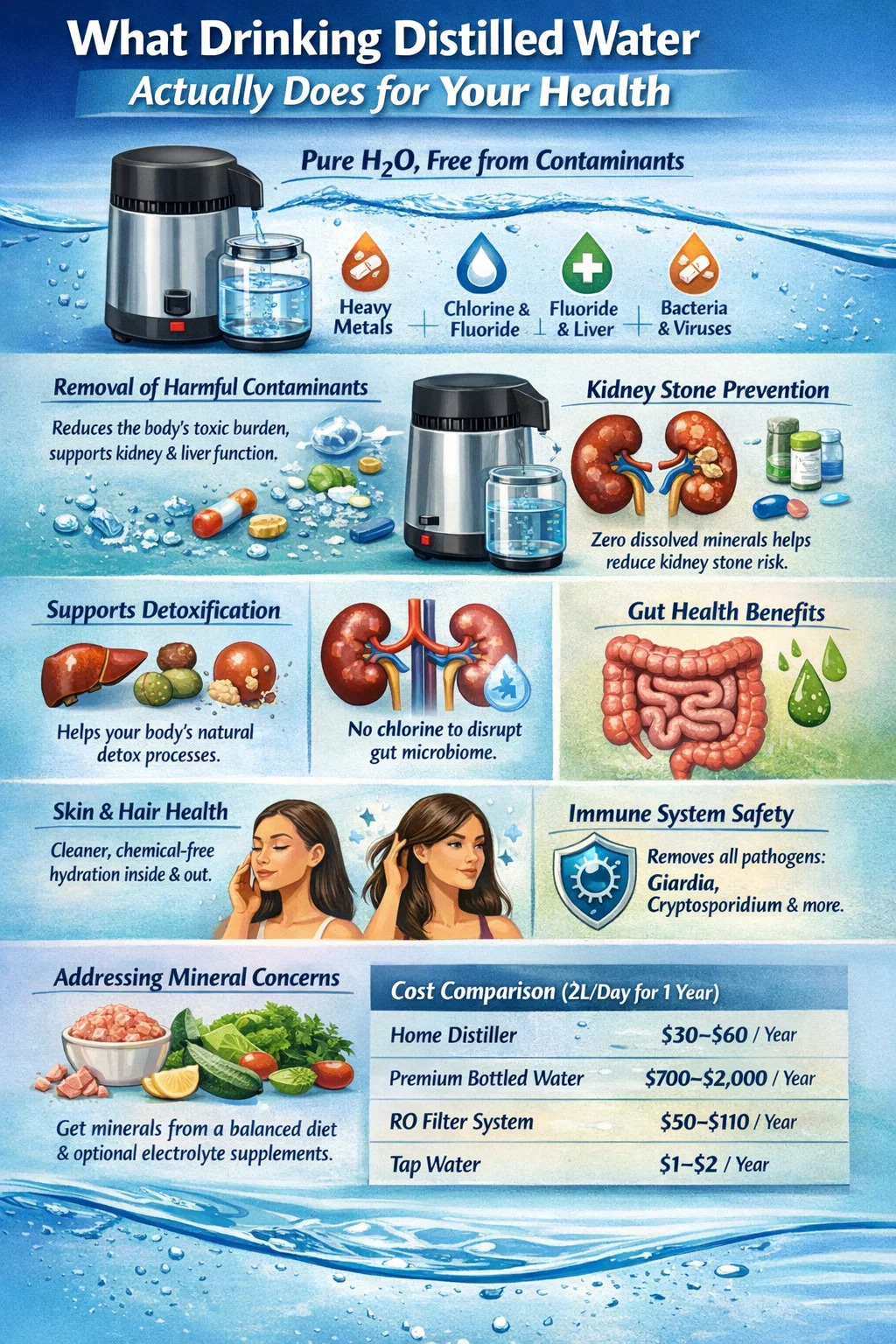
Distilled water is one of the purest forms of water available. It is produced by boiling water into steam and condensing it back into liquid, leaving behind dissolved solids, heavy metals, chlorine, fluoride, bacteria, and most other contaminants. The core health benefit is straightforward: you are consuming water with virtually zero chemical or biological load, which reduces your body's burden of processing unwanted substances every time you hydrate.
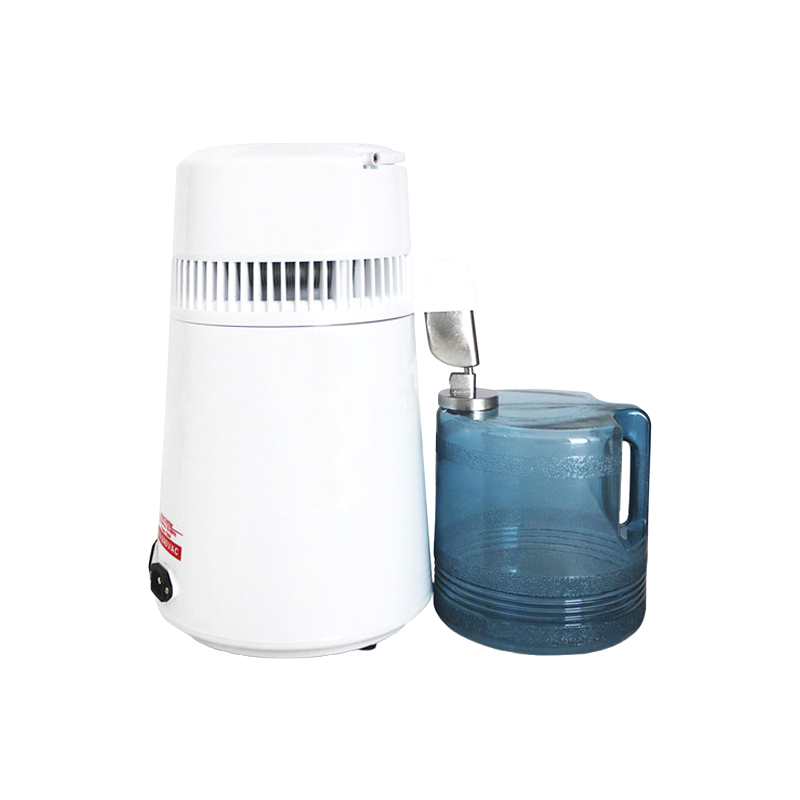
Many people turn to a Water Distiller specifically because they are concerned about what comes out of their tap. Municipal water supplies, while treated, still contain residual chlorine, chloramines, trace pharmaceuticals, nitrates, and sometimes heavy metals like lead or copper — particularly in older homes with aging pipes. Well water can carry its own set of issues including arsenic, bacteria, and agricultural runoff. Distilled water sidesteps all of these concerns by going through a physical purification process that does not rely on chemical additives.
This article breaks down the specific, evidence-based benefits, addresses common concerns such as mineral loss, and explains who stands to benefit most from regularly drinking water produced by a home Water Distiller.
The most direct and well-documented health benefit of distilled water is its near-total absence of contaminants. The distillation process removes:
When your body is not constantly processing these low-level toxins, the organs responsible for filtration — primarily the kidneys and liver — operate under less stress. Over months and years, this can make a real difference, particularly for people who are already dealing with chronic conditions or who live in areas with known water quality problems.
A 2019 report from the Environmental Working Group (EWG) found over 250 different contaminants in U.S. tap water, many of which standard municipal treatment does not fully eliminate. For households relying on such water, a countertop or home Water Distiller represents a practical and cost-effective solution to that problem.
Kidney stones affect roughly 1 in 10 people at some point in their lifetime, and their formation is closely tied to the mineral content of what you consume. The most common type — calcium oxalate stones — can be influenced by high levels of calcium and certain minerals in drinking water.
Hard water, which is water with high dissolved mineral content (typically above 120 mg/L of calcium carbonate), has been associated in some studies with increased kidney stone risk. Distilled water contains essentially zero dissolved minerals, which means it does not contribute to the mineral load that can accumulate in the urinary tract.
For individuals who have a history of kidney stones or who are genetically predisposed to them, switching to distilled water as their primary drinking water — while maintaining mineral intake through a balanced diet — is a common recommendation from urologists. The kidneys also benefit from not having to filter out inorganic minerals that the body cannot use, potentially reducing micro-inflammation in renal tissue over time.
| Water Type | Avg. TDS (mg/L) | Calcium (mg/L) | Chlorine Present | Heavy Metals |
|---|---|---|---|---|
| Distilled Water | 0–1 | ~0 | No | None detected |
| Tap Water (US avg) | 150–400 | 20–100 | Yes | Trace amounts |
| Hard Tap Water | 400–1000+ | 100–300+ | Yes | Possible |
| Spring Water | 50–500 | 10–150 | Usually No | Varies |
| RO Filtered Water | 10–50 | 1–10 | Mostly No | Mostly removed |
The human body has its own built-in detoxification systems — the liver, kidneys, lymphatic system, and skin all play roles in processing and eliminating waste. What often gets overlooked is that these systems require clean water to function efficiently. When the water you drink is already loaded with contaminants, your detox systems spend energy processing the water itself rather than clearing out metabolic waste and environmental toxins your body has already accumulated.
Distilled water, because it is essentially a blank slate chemically, can act as a more effective carrier fluid. Its low solute concentration means it may more readily pull dissolved waste products out of tissues and toward the kidneys for excretion. This is the basic principle behind why some naturopathic practitioners and detox protocols recommend distilled water during cleansing periods.
It is worth noting that this does not mean distilled water is some kind of magical detox agent — the detoxification happens through normal physiological processes. What distilled water does is remove obstacles to those processes. Think of it like cleaning a filter: you do not add cleaning agents to the filter, you run clean water through it. Using a Water Distiller to produce clean water is one of the simplest ways to support — rather than burden — your body's natural filtration systems.
The connection between water quality and digestive health is underappreciated. Chlorine and chloramines, added to municipal water to kill pathogens, do not suddenly become harmless once they enter your body. There is a growing body of research suggesting that chronic chlorine ingestion may disrupt the gut microbiome — the community of beneficial bacteria in your digestive tract that plays roles in immunity, mood regulation, nutrient absorption, and metabolic function.
A study published in the journal Environmental Science & Technology identified chlorination byproducts as potential disruptors of intestinal flora balance. While the research is still evolving, the mechanism is logical: if chlorine kills bacteria in your pipes, it may also affect bacterial populations in your gut to some degree.
Distilled water contains no chlorine, chloramines, or their byproducts. For people who have been working on improving their gut health through probiotics, fermented foods, or dietary changes, switching from chlorinated tap water to distilled water removes one potential ongoing source of disruption to those efforts.
Hydration quality directly impacts the skin. When you drink water free of dissolved solids and chemical additives, your cells receive hydration without any accompanying chemical load. While studies specifically isolating distilled water's effect on skin hydration versus tap water are limited, the broader link between clean hydration and skin health is well-established.
Internally, reduced exposure to chlorine and heavy metals through your drinking water may contribute to less oxidative stress at the cellular level. Oxidative stress is one of the primary drivers of accelerated skin aging — it degrades collagen, causes uneven pigmentation, and reduces skin elasticity. Drinking clean, contaminant-free water is one of the most basic and underrated strategies for maintaining skin health from the inside out.
When used externally, distilled water is also commonly preferred for:
Dermatologists dealing with patients who have eczema, psoriasis, or persistent contact dermatitis sometimes recommend reducing exposure to hard or heavily chlorinated water as part of a management plan. A home Water Distiller provides a consistent, reliable source of pure water for both drinking and topical use.
For immunocompromised individuals — including those undergoing chemotherapy, people with HIV/AIDS, organ transplant recipients, and the elderly — water safety is not a theoretical concern, it is a clinical one. Pathogens like Cryptosporidium and Giardia that can survive standard chlorination treatment have caused serious illness in immunocompromised patients who consumed contaminated tap water.
The U.S. Centers for Disease Control and Prevention (CDC) specifically recommends that immunocompromised individuals either boil their water or use a certified water purification method. Distillation is one of the most comprehensive purification methods available and is explicitly listed as an acceptable option in public health guidelines for this population.
Distilled water eliminates biological contamination risk entirely — not by adding a chemical treatment, but by physically separating water molecules from everything else through the heat-and-condensation process. For people whose immune systems cannot afford even minor pathogenic exposure, a Water Distiller offers a level of security that filters alone cannot guarantee.
This is the most common objection to drinking distilled water, and it deserves a thorough, honest answer. The concern is that because distilled water has no dissolved minerals, it will pull minerals out of your body's tissues and bones as it passes through — essentially acting as a mineral sponge.
The reality is more nuanced. Water — including distilled water — does not actively strip minerals from healthy tissues. The human body maintains mineral homeostasis through hormonal regulation (parathyroid hormone, calcitonin, aldosterone, etc.), not simply by letting whatever is in your drinking water dictate your mineral balance.
However, there is a partial truth to the concern. Distilled water, being slightly acidic (pH around 5.5–6.5 due to dissolved CO₂), can leach small amounts of minerals from whatever container it is stored in — and it may absorb trace minerals from food during cooking more readily than mineral-rich water does. When people drink large quantities of distilled water while also eating a nutritionally poor diet with low mineral intake, there is a theoretical risk of depleting electrolyte reserves over time.
That said, the vast majority of your daily mineral intake comes from food, not water. Dietary sources provide more than 90% of your calcium, magnesium, and potassium requirements. As long as you are eating a diet that includes vegetables, legumes, dairy, nuts, seeds, or any reasonable variety of whole foods, the mineral content of your water is a minor variable.
The health benefits of using a Water Distiller extend beyond what you drink directly. The water you use to cook vegetables, boil grains, make soups, and brew tea or coffee also matters. Tap water used in cooking introduces the same contaminants — chlorine, heavy metals, nitrates — into your food. At higher cooking temperatures, some of these compounds can become more concentrated as water evaporates.
Using distilled water for cooking means that your food is prepared in a chemically clean medium. Vegetables boiled in distilled water are not absorbing chlorine or trace metals during cooking. Rice and grains steamed in distilled water start from a clean baseline. Tea brewed with distilled water does not have the flat, chemical aftertaste that chlorinated tap water can produce — it also preserves the delicate polyphenol profile of high-quality teas more accurately.
For households that are serious about the quality of what goes into their bodies, using distilled water throughout the kitchen — not just for drinking — is the logical extension of the same principle. A single countertop Water Distiller can produce enough water for both drinking and regular cooking needs, typically 4–6 liters per cycle depending on the model.
While clean water is beneficial for everyone, certain groups have more pressing reasons to prioritize distilled water as their primary source:
A common barrier to adoption is the perception that distilled water is expensive or inconvenient. In practice, a home Water Distiller offers a significantly better cost-per-liter ratio than buying bottled water and is more reliable than many filter systems when it comes to purity.
A quality countertop Water Distiller typically costs between $150–$500 depending on capacity and features. Operating costs (electricity) for producing one liter of distilled water average around $0.03–$0.06 per liter, depending on local electricity rates. By comparison, premium bottled water in Europe or North America costs anywhere from $0.50 to $3.00 per liter at retail. A home Water Distiller pays for itself within weeks to months, depending on household consumption.
Maintenance is minimal — periodic cleaning of the boiling chamber to remove mineral scale (which is precisely the material being removed from your water) and occasional replacement of the post-distillation carbon filter, which handles any remaining volatile organic compounds that may carry over during distillation.
| Water Source | Avg. Cost per Liter | Annual Cost (2L/day) | Purity Level |
|---|---|---|---|
| Home Water Distiller | $0.03–$0.06 | $22–$44 + unit cost | Highest |
| Premium Bottled Water | $1.00–$3.00 | $730–$2,190 | Variable |
| Standard Bottled Water | $0.30–$0.80 | $219–$584 | Moderate |
| Under-sink RO Filter | $0.05–$0.15 | $36–$110 + unit cost | High |
| Tap Water (municipal) | $0.001–$0.003 | $0.70–$2.20 | Low–Moderate |
There are several water purification methods available to consumers, and each has its place. Understanding where distillation fits in that landscape helps you make an informed decision rather than just defaulting to whatever is most marketed.
The main practical trade-off with distillation is time — a standard countertop Water Distiller takes 4–6 hours to produce approximately 4 liters of water. For most households, this simply means running the unit overnight or while at work, which is a minor inconvenience relative to the purity it delivers.
The health benefits of drinking distilled water are real, but they are primarily benefits of absence — the absence of contaminants, pathogens, unwanted minerals, and chemical additives. This is not a minor thing. Given that the average person consumes roughly 700–1,000 liters of water per year, the cumulative difference between consistently clean water and contaminated water over a lifetime is significant.
Distilled water is not a cure for any condition, but it removes a persistent, low-level source of chemical exposure from your daily life. For people with specific health concerns — kidney stones, compromised immunity, chemical sensitivities, gut health issues, or concerns about heavy metal exposure — the case for a home Water Distiller is particularly strong.
For the general healthy adult, the benefit is more long-term and preventative in nature: reducing the body's total toxic burden, supporting the kidneys and liver in their natural function, and ensuring that the most fundamental nutritional input — water — is as clean as it can possibly be. Paired with a mineral-rich diet, distilled water is a practical, affordable, and scientifically sound choice for anyone who takes their health seriously.
If you have any question for the installation
or need support, please feel free to contact us.
86-15728040705
86-18957491906

 English
 عربى
عربى

