Content
A vacuum autoclave removes air from the chamber before and after sterilization, which lets steam penetrate hollow instruments, handpieces, and wrapped packs completely. A non vacuum autoclave relies on gravity displacement, pushing air out as steam fills the chamber from the top down. For a practice running a dental autoclave daily, this single difference decides whether turbines, tubing, and porous loads come out fully dry and sterile, or whether trapped air pockets leave cold spots where bacteria can survive.
If the load is mostly solid, unwrapped instruments, a non vacuum class N or class S cycle is usually sufficient. If the load includes handpieces, hollow needles, fabric wraps, or pouched instruments, a class B vacuum dental autoclave is the safer and often the required choice for most clinical sterilization workflows.
The rest of this guide breaks down exactly why that gap exists, how each cycle behaves at the mechanical level, what the class ratings really mean, how long each cycle actually takes, what it costs to own and run either type, and how to decide which one belongs on your counter based on real daily caseload rather than guesswork.
Steam enters the chamber from above and pushes cooler, denser air downward and out through a drain valve at the bottom. This works well for solid metal items with no internal channels, since air has a clear, direct path to escape. The problem appears with anything that has a cavity, a lumen, or layers of fabric: air becomes trapped in places gravity alone cannot reach, and steam simply cannot displace what it cannot touch.
A vacuum pump pulls air out of the chamber before steam is introduced, often in several pulses rather than a single draw, creating a near-total vacuum that steam then fills evenly from every angle, including inside narrow channels. After sterilization holds for the required time, a second vacuum phase pulls out residual moisture, leaving wrapped packs dry enough for immediate storage rather than sitting damp on a tray.
The mechanical difference sounds small on paper, a pump versus a drain valve, but it changes what categories of instruments the machine can be trusted with. Gravity can only push air in one direction. A vacuum pump can pull air out of a shape no matter how the shape is oriented inside the chamber, which is exactly why hollow and wrapped instruments need it.
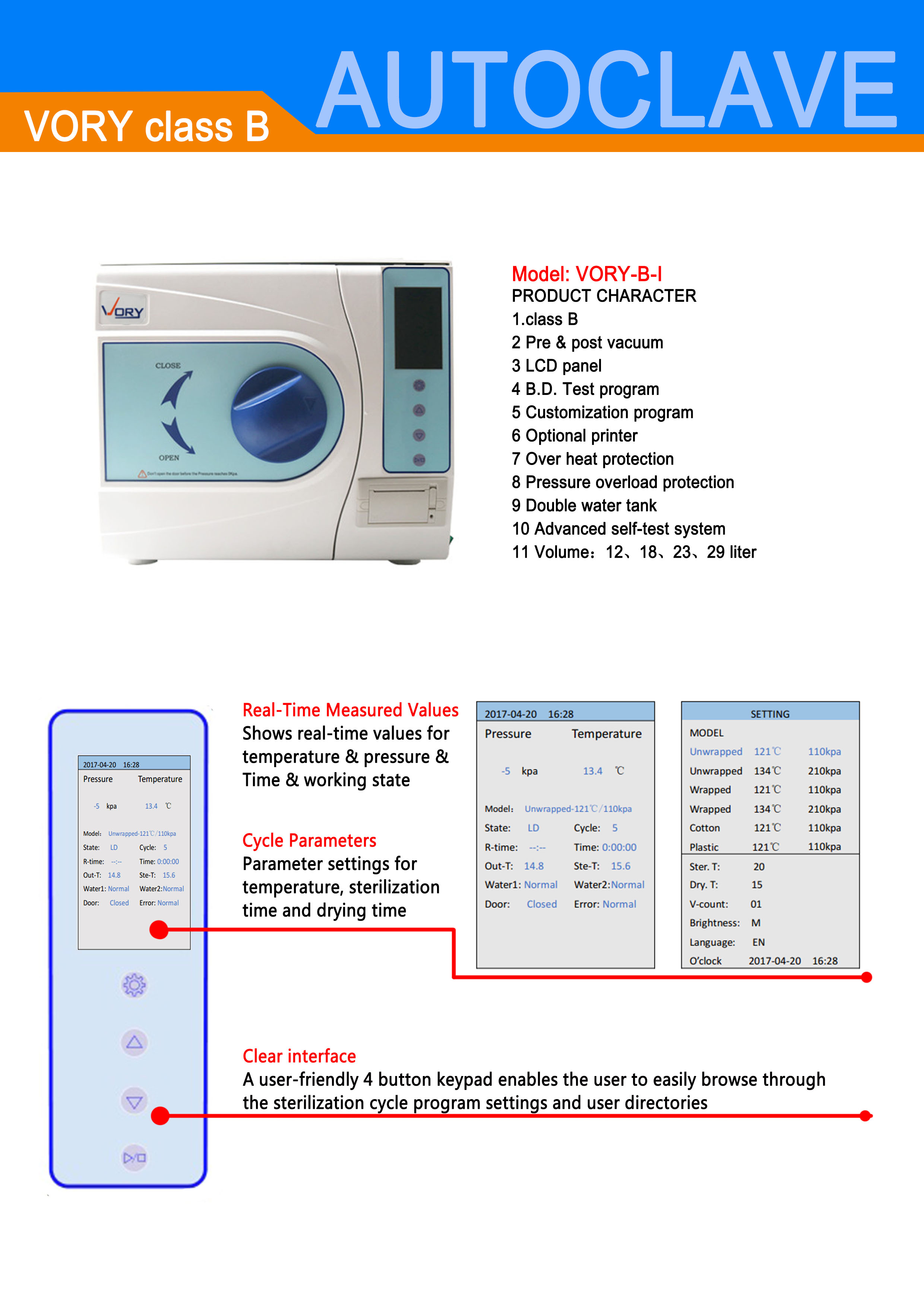
Instruments are arranged so steam can reach every surface, and the door locks to form a pressure-tight seal. Overcrowding the chamber is the single most common loading mistake, since it blocks steam circulation regardless of which sterilization method is used.
In a non vacuum unit, steam begins flooding the chamber immediately and air is pushed out through the drain. In a vacuum unit, a pump draws the chamber down to a partial vacuum, sometimes repeating this two to four times, before steam is admitted at all.
Chamber temperature is held at a target, commonly 121°C to 134°C, for a fixed exposure time. Higher temperature cycles run shorter holds; lower temperature cycles run longer holds, since the two variables trade off against each other.
Steam pressure is released gradually to avoid a rapid pressure drop, which can cause liquids to boil violently or damage delicate packaging if released too fast.
A vacuum unit pulls a final vacuum to evaporate residual moisture from wrapped loads. A non vacuum unit typically skips this step entirely or offers only a brief, passive drying window, which is why instruments often come out visibly damp.
| Factor | Non Vacuum Autoclave | Vacuum Autoclave |
|---|---|---|
| Air removal method | Gravity displacement | Mechanical vacuum pump |
| Hollow instrument penetration | Limited, risk of air pockets | Complete, even penetration |
| Suitable for wrapped loads | Not reliable | Yes, designed for it |
| Drying result | Often leaves residual moisture | Dry packs ready for storage |
| Typical full cycle length | 15-30 minutes | 18-45 minutes including drying |
| Chamber size range typical for clinics | 12-18 liters | 17-23 liters |
| Equipment cost | Lower upfront cost | Higher upfront cost |
| Service complexity | Lower, fewer moving parts | Higher, vacuum pump adds upkeep |
Dental autoclaves are commonly grouped into three class ratings based on what they can reliably sterilize. Understanding these classes matters more than the brand name on the unit, since the class determines what loads are actually safe to run.
Suitable only for solid, unwrapped instruments processed immediately after the cycle ends. No hollow items, no wrapped packs, no porous fabric loads. This is the most basic and most limited class.
Still gravity-based, but with manufacturer-specified additional capabilities such as some wrapped or hollow items. The exact load list varies by manufacturer and must be checked directly against the equipment documentation rather than assumed.
Capable of sterilizing wrapped, porous, and hollow loads including handpieces and endodontic files, matching the toughest test loads used in sterilization validation testing. This is the only class that reliably handles every instrument type found in a typical dental operatory.
A practice that only ever processes solid mirrors and probes can function with a class N unit. A practice running handpieces, ultrasonic tips, or any wrapped surgical kit needs class B performance, which in practice means a vacuum dental autoclave.
134°C
Typical chamber temperature for a fast vacuum sterilization cycle, compared to 121°C commonly used in slower gravity cycles.
3-6
Number of vacuum pulses a class B cycle typically performs before and after sterilization to strip trapped air from hollow channels.
18-45 min
Approximate full cycle range for a vacuum autoclave including drying, versus 15-30 minutes for a basic non vacuum cycle without a drying phase.
0.1-0.2 bar
Approximate residual pressure left in the chamber during a deep vacuum pulse, low enough that steam can flood every void almost instantly once admitted.
The danger with trapped air is not visible to the eye. Steam cannot reach a surface that air is occupying, so a pocket of unremoved air becomes a cold spot where the temperature never climbs high enough or stays high enough long enough to kill spores. Solid instruments rarely have this problem. Handpieces with internal turbines, syringe tips, and anything wrapped in pouches or cloth are far more vulnerable to incomplete sterilization in a gravity-only cycle.
| Practice Profile | Recommended Type |
|---|---|
| General cleaning, no handpieces processed | Class N non vacuum |
| Mixed solid and occasional hollow items | Class S, check manufacturer load list |
| High volume, handpieces, surgical kits, wrapped storage | Class B vacuum autoclave |
| Multi-chair clinic with continuous turnover | Class B vacuum autoclave with fast cycle option |
Chair count and daily instrument turnover matter as much as the type of work performed. A single-chair practice doing simple checkups can often manage with a smaller non vacuum unit and a longer cycle. A multi-chair clinic processing several handpiece sets per hour needs a vacuum autoclave with a fast cycle option, or instrument turnover becomes the bottleneck for the entire schedule.
The sticker price is only one part of the comparison. A vacuum dental autoclave generally costs more upfront because of the added pump, valves, and control logic, but the long-run cost picture depends heavily on cycle volume and what the practice is trying to sterilize.
Non vacuum units are typically the lower-cost option to purchase, reflecting their simpler mechanical design and shorter parts list.
Vacuum units need periodic attention to the pump and its seals, an extra line item that non vacuum units simply do not have.
Longer cycles with vacuum pulses and a drying phase use somewhat more water and energy per cycle than a basic gravity run.
Re-running a cycle, replacing a damaged handpiece, or dealing with a contaminated wrapped pack costs more in time and instruments than the price difference between unit types.
For a practice handling any hollow or wrapped instruments, the cost of repeatedly risking incomplete sterilization, or replacing handpieces damaged by improper processing, generally outweighs the price gap between a non vacuum and a vacuum unit within the first year or two of use.
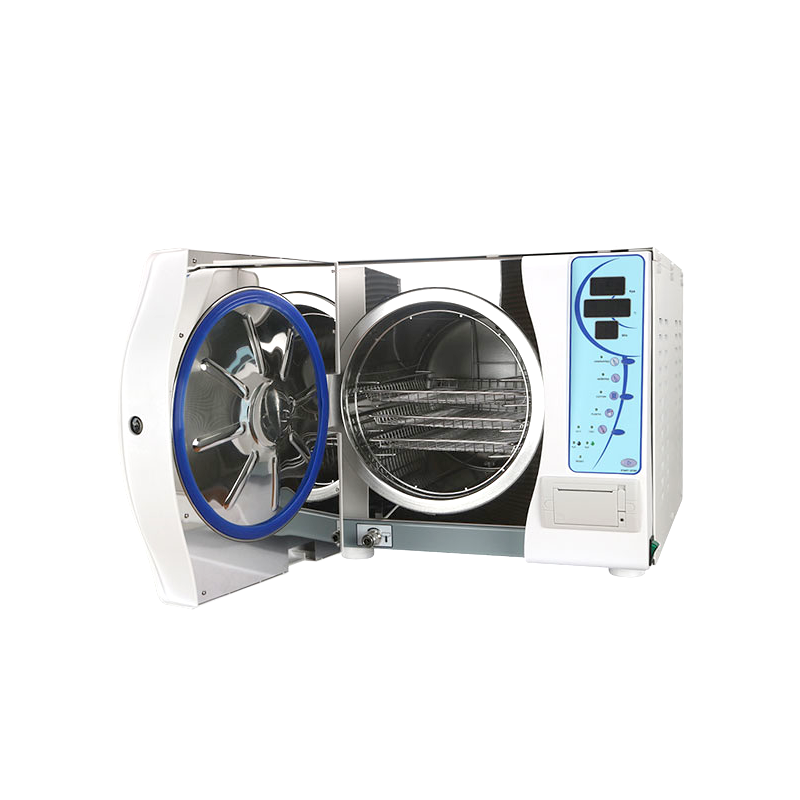
Vacuum autoclaves contain a mechanical vacuum pump, which is an additional component that needs periodic servicing and is the most common point of failure in these units. Non vacuum autoclaves have fewer moving parts and generally lower maintenance demands, but they also cannot perform the drying phase that prevents wet packs and instrument corrosion over time.
It is not recommended. Handpieces have narrow internal channels where air pockets form easily in a gravity displacement cycle, leaving parts of the internal surface unsterilized even when the outer surface reaches the correct temperature.
The added time comes from the vacuum pulses before sterilization and the drying vacuum phase afterward. Both phases are what make wrapped and hollow loads safe and dry, so the extra minutes directly translate into a more complete result.
Class B describes a performance standard, and in practice a unit only reaches class B by using a fractionated vacuum cycle. So while not every vacuum machine is automatically class B, every class B machine is a vacuum autoclave.
Wrapped instruments need to come out fully dry to maintain sterility during storage. A non vacuum cycle often leaves residual moisture inside the wrap, which can compromise the seal and allow recontamination before the instrument is used.
Most class B vacuum autoclaves include selectable cycles, so the same unit can run a faster gravity-style cycle for solid loads and a full vacuum cycle for wrapped or hollow loads, giving a practice flexibility without owning two machines.
Chamber size only changes how many instruments fit per cycle. It has no bearing on whether air can be fully removed from hollow or wrapped items, which depends entirely on whether the unit has vacuum capability.
A Bowie-Dick test is typically run at the start of each working day before the first load of wrapped instruments, since it confirms steam is penetrating porous materials correctly before the unit is trusted with real loads.
If you have any question for the installation
or need support, please feel free to contact us.
86-15728040705
86-18957491906

 English
 عربى
عربى

